Education & Training
Educating the next generation of clinical/translational scientists

Home » Here
In this section
Education & Training
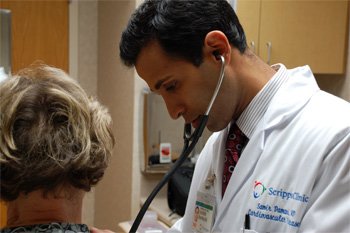 Samir Damani, M.D., PharmD., a former clinical scholar, examines one
of his patients during a periodic check-up at Scripps Clinic.
He also conducts research on circulating endothelial cells
in cardiovascular disease.
The Scripps Translational Science Institute (STSI) has created an academic education and training program with the overarching objective of identifying, inspiring and nurturing the next generation of translational scientists. Participating in the program, which is supported by the NIH Clinical and Translational Award (CTSA), are Scripps Health physician-scientists and The Scripps Research Institute (TSRI) and Kellogg School of Science and Technology graduate students in the basic sciences.
STSI’s education and training program integrates and expands the resources, activities and personnel of Scripps Health and TSRI, both pre-eminent institutions in their respective fields of research, education and clinical care.
Physicians-in-training who complete the program receive the Master’s of Science in Clinical and Translational Investigation (Master’s) from TSRI’s Kellogg School of Science and Technology. When they are awarded the Ph.D. from the Kellogg School of Science and Technology, TSRI graduate students are recognized for completing STSI’s Translational Research for Advanced Doctoral Students curriculum. The physicians in-training and the advanced doctoral students participate in the same classes and seminars in advanced molecular medicine, biostatistics, clinical trial design and other topics relevant to translational research.
However, the program includes many activities that enable the doctoral students to learn about particular diseases from the viewpoints of the patients and physicians. Likewise, the physicians-in-training obtain hands-on experience in laboratory research in the basic sciences.
In addition to the Master’s of Science in Clinical and Translational Medicine and the Translational Research for Advanced Doctoral Students, STSI sponsors the Wireless Health Scholar, to train a cadre of the young physicians in the Master’s program to become the leading investigators testing, exploring and validating new wireless medical technologies.
With Scripps Genomic Medicine, STSI also sponsors the annual Future of Genomic Medicine annual conferences as well as seminars and numerous other meetings.
James R. Williamson, Ph.D.
Co-Director, Education
Dean, TSRI Kellogg School
Laura Nicholson, M.D., Ph.D.
Co-Director, Education
Associate Professor, STSI
Program Contact
Katrina Schreiber
.(JavaScript must be enabled to view this email address)
Ph: (858) 554-5708
Master’s in Clinical and Translational Investigation
A core component of the Clinical and Translational Science Award of the NIH and of the Scripps Translational Science Institute (STSI) is the education and cultivation of the next generation of clinical/translational scientists.
Translational Research for Advanced Doctoral Students
A core component of The Scripps Research Institute (TSRI) and its Kellogg School of Science and Technology is educating and training the upcoming generation of biomedical scientists.
Wireless Health Scholar
The Wireless Health Scholar program prepares energetic and scientifically-minded young and mid-career physicians to become the leading investigators in testing, exploring and validating evolving wireless medical sensing and therapy devices.
Student Research Internship
Scripps Genomics Primer
Educational Tools
We’ve gathered a collection of useful tools — iPhone apps to websites — for visitors to enhance their understanding beyond the Scripps Genomics Primer.